One of the most common questions people ask after deciding to rooftop solar installation is whether they should also invest in a battery storage system. While solar panels generate electricity during daylight hours, a battery allows some of that energy to be stored and used later, especially during power outages or after sunset. This sounds like the perfect solution, but the answer isn't the same for everyone.
For some homeowners and businesses, battery storage provides peace of mind and uninterrupted power during electricity failures. For others, especially those living in areas with reliable electricity supply and access to net metering, the additional investment may not provide enough financial benefit to justify the higher installation cost.
Modern battery technology has become more efficient, safer, and longer lasting than earlier generations. However, batteries remain one of the most expensive components of a solar energy system. Before making a decision, it is important to understand how battery storage works, who actually benefits from it, and whether it aligns with your electricity usage, budget, and long-term energy goals.
What is Solar Battery Storage?
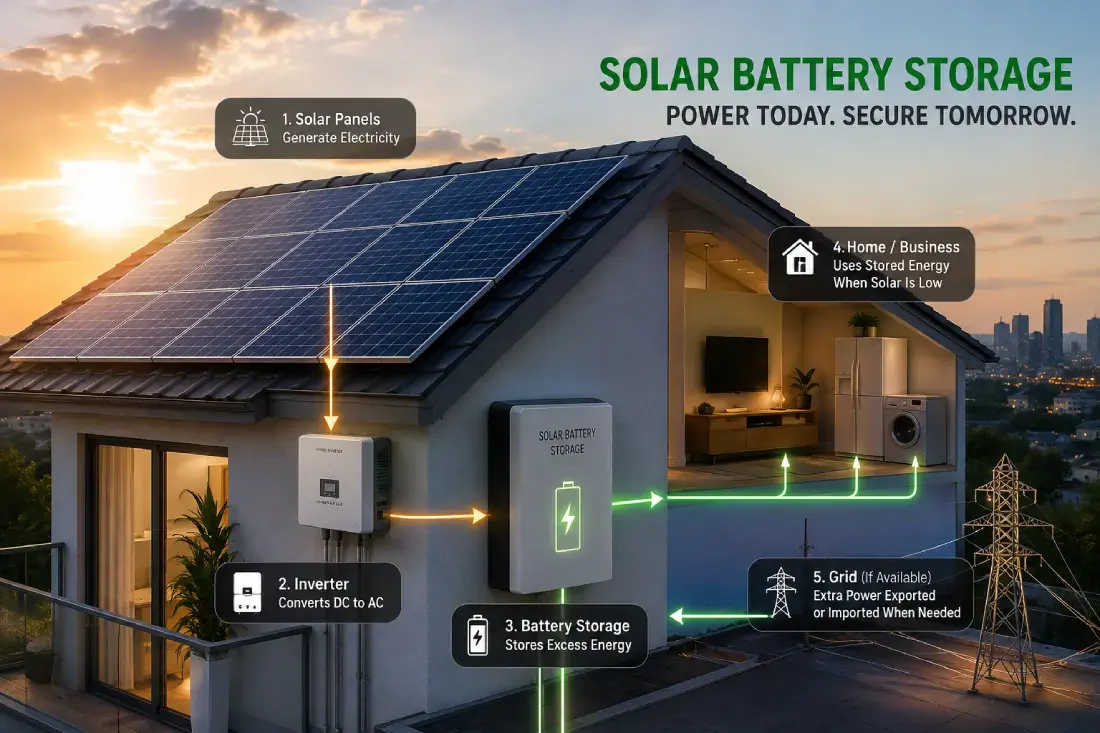
A solar battery is a device that stores excess electricity generated by your rooftop solar panels. Instead of sending all unused electricity to the power grid, the battery stores it for later use when solar generation is low or unavailable.
During the daytime, solar panels first supply electricity to your home or business. If your system produces more electricity than your appliances require, the remaining energy can either be exported to the electricity grid through net metering or stored inside the battery, depending on the type of solar system installed.
Later, during the evening, cloudy weather, or power outages, the stored energy is discharged to operate selected electrical appliances without relying entirely on the grid.
How Does a Solar Battery Work?
Although battery technology is highly advanced, its operation is simple from the user's perspective.
The process generally follows these steps:
Solar panels generate electricity during daylight.
Appliances consume the generated electricity.
Excess electricity charges the battery.
Once the battery reaches full capacity, additional electricity may be exported to the grid if net metering is available.
During the evening or power failure, the battery supplies stored electricity.
When battery capacity becomes low, electricity is automatically drawn from the grid if available.
Everything operates automatically without requiring manual switching.
Types of Solar Batteries
Lead-Acid Batteries
Lead-acid batteries have been used for decades and remain one of the most affordable options for backup power. They are suitable for applications where budget is the primary concern but generally require regular maintenance and have a shorter lifespan.
They are commonly chosen for:
Small backup systems.
Budget installations.
Occasional power backup.
Lithium-Ion Batteries
Lithium-ion batteries have become the preferred choice for modern rooftop solar systems because they offer high efficiency, faster charging, compact size, and longer service life.
Major advantages include:
High charging efficiency.
Low maintenance.
Compact design.
Long operational life.
Better performance during frequent charging and discharging.
These batteries are now widely used in residential and commercial solar installations.
Lithium Iron Phosphate (LFP) Batteries
LFP batteries are one of the most popular battery technologies for solar applications due to their excellent safety, thermal stability, and long cycle life.
Their advantages include:
Excellent safety.
Long lifespan.
Stable performance.
Minimal maintenance.
Reliable daily operation.
Many premium hybrid solar systems now use LFP batteries because of their durability.
Benefits of Adding Battery Storage
Battery storage offers advantages that extend beyond simple electricity savings.
Some of the biggest benefits include:
Backup during power outages.
Better energy independence.
Reduced dependence on diesel generators.
Ability to use solar energy after sunset.
Protection against future electricity tariff increases.
Improved energy management.
Continuous power for essential appliances.
For businesses, battery storage can also reduce downtime caused by unexpected power interruptions.
When is Battery Storage Worth the Investment?
Battery storage is most valuable when uninterrupted electricity is more important than simply reducing electricity bills.
It is often a good investment for:
Homes experiencing frequent power cuts.
Rural areas with unreliable electricity supply.
Medical facilities.
Offices operating critical computer systems.
Businesses requiring continuous operations.
Homes with essential medical equipment.
Off-grid locations.
Properties using diesel generators frequently.
In these situations, the value of uninterrupted power often outweighs the additional installation cost.
When You May Not Need a Battery
Not every rooftop solar system requires battery storage.
If your area has reliable electricity and your solar system is connected through net metering, adding batteries may significantly increase your investment without providing substantial financial returns.
Battery storage may not be necessary if:
Electricity supply is stable.
Your primary goal is reducing electricity bills.
Net metering is available.
Budget is limited.
You mainly consume electricity during daytime.
Backup power is rarely required.
For many urban homeowners, a grid-connected solar system without batteries remains the most economical option.
Factors to Consider Before Buying a Solar Battery
Before investing in battery storage, homeowners and businesses should evaluate several important factors instead of focusing only on price.
Important considerations include:
Daily electricity consumption.
Frequency of power outages.
Required backup duration.
Available installation space.
Battery technology.
Warranty period.
Charging efficiency.
Maintenance requirements.
Future expansion plans.
Budget.
Selecting the right battery capacity is just as important as choosing the right solar system size.
Common Mistakes to Avoid
Battery storage is a long-term investment, and choosing the wrong system can reduce both performance and financial returns.
Avoid these common mistakes:
Buying batteries without calculating backup requirements.
Choosing capacity based only on price.
Ignoring battery warranty.
Installing incompatible inverters.
Underestimating future electricity usage.
Skipping professional system design.
Purchasing low-quality batteries from unknown manufacturers.
Proper planning ensures better performance and longer battery life.
Can Batteries Be Added Later?
Yes. One advantage of many modern hybrid solar systems is that they allow battery storage to be added at a later stage. This flexibility enables homeowners to begin with a standard grid-connected rooftop solar installation and upgrade to battery storage whenever their requirements change.
This approach is particularly useful for homeowners who currently have reliable electricity but anticipate future backup needs or expect battery technology to become even more affordable.
Planning for future battery expansion during the initial solar installation can simplify the upgrade process and reduce future installation costs.
Solar-Only vs Solar with Battery
Choosing between a standard grid-connected solar system and a battery-supported hybrid system depends entirely on your priorities.
A solar-only system is generally the better choice if your primary goal is reducing electricity bills and your area has reliable grid power.
A solar-plus-battery system is usually the better option if uninterrupted electricity, energy independence, and backup power are equally important.
Rather than asking which option is universally better, homeowners should evaluate which solution best matches their daily electricity usage and long-term requirements.
Conclusion
Adding battery storage to a rooftop solar system can significantly improve energy independence and provide reliable backup during power outages, but it is not the right solution for every property. Homes and businesses experiencing frequent electricity interruptions or requiring uninterrupted power often benefit the most from battery storage, while properties with stable grid supply and effective net metering may achieve better financial returns with a standard grid-connected solar system. By carefully evaluating your electricity consumption, backup requirements, budget, and future energy needs, you can choose a solution that delivers the best balance between performance, reliability, and long-term value.